Slim Milkweed
Asclepias linearis Scheele
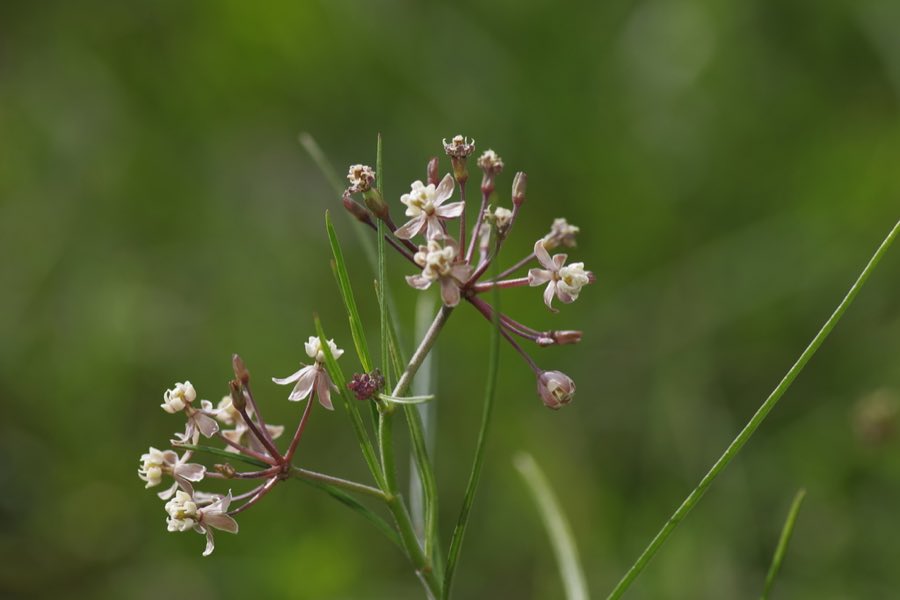
A Texas endemic of coastal and blackland prairie, wiry and many-stemmed, with thread-fine opposite leaves and small greenish-white flowers. Known from the middle and upper Gulf Coast north to the Dallas area and nowhere else in the United States.
- Height
- 8 in–1.7 ft
- Spread
- 8 in–1.3 ft
- Flowers
- white, green
- Bloom
- May to November
- Light
- Full sun
- Soil moisture
- Dry, Average
- USDA zones
- 8–10
- Leaves
- Opposite, threadlike
- Sap
- Milky latex
- Roots
- Deep taproot, resents transplanting
- Stratification
- 30 days cold-moist
- Range
- 1 state
When it flowers
Slim Milkweed blooms May to November, peaking in May and June.
How to identify it
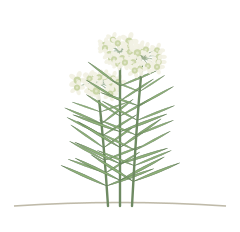
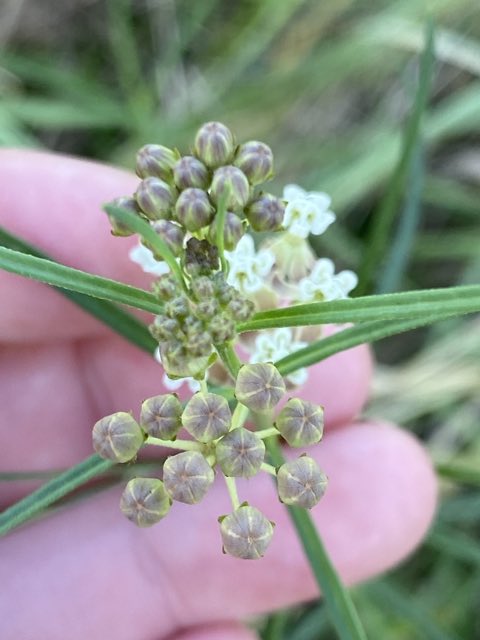
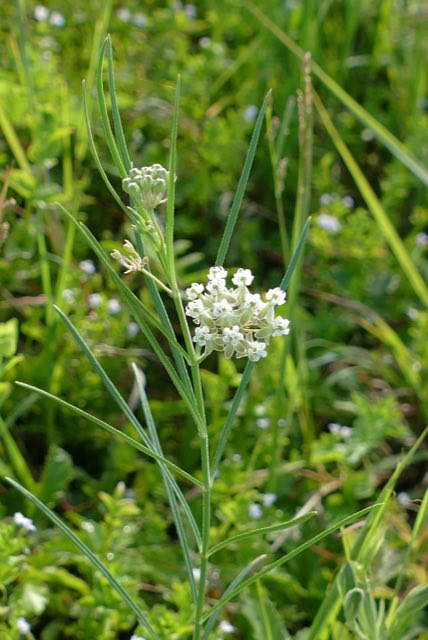
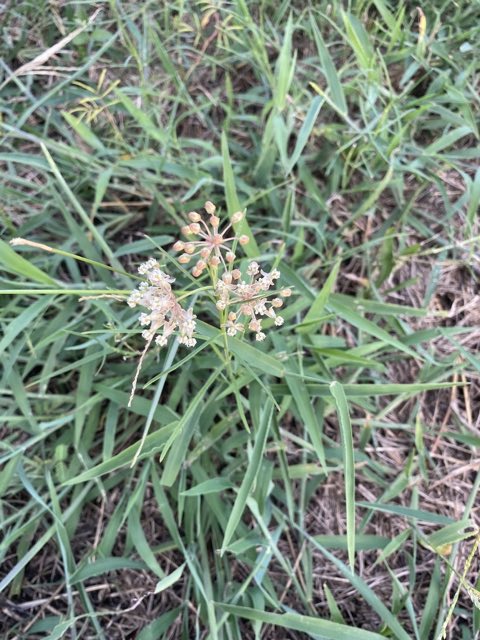
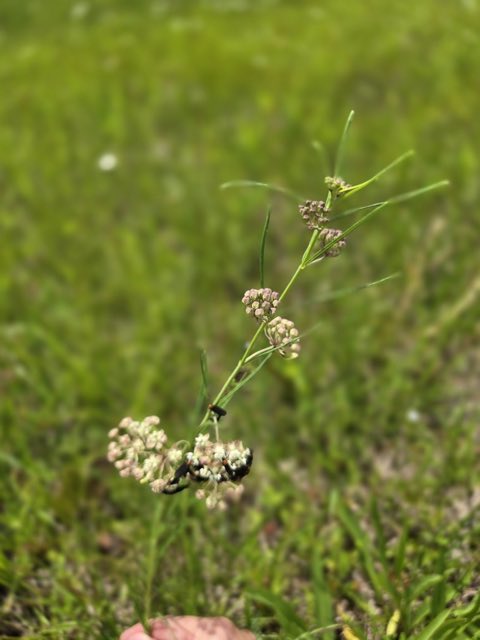
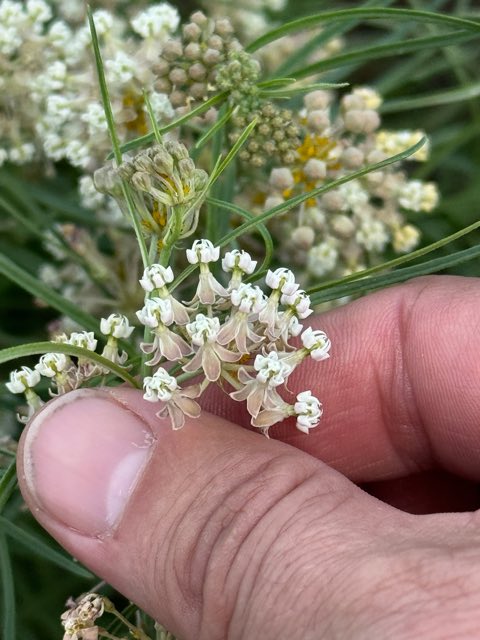
- Thread-fine linear leaves only 1 to 4 mm wide and 3 to 9 cm long, stalkless or nearly so.
- Leaves are opposite, not in whorls. This is the main separation from whorled milkweed, which carries them in rings of four to six.
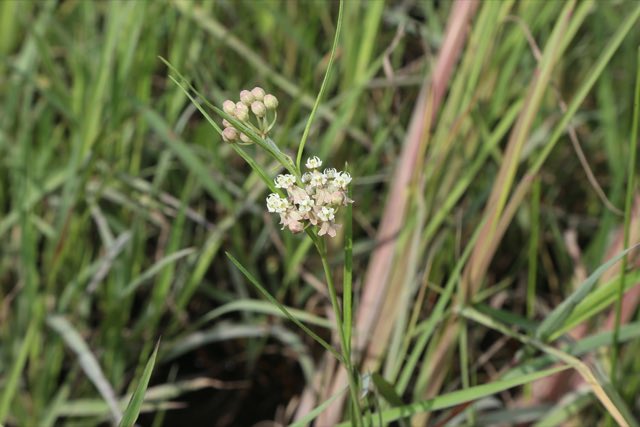
- Slender erect stems, usually several from the base, 20 to 50 cm tall.
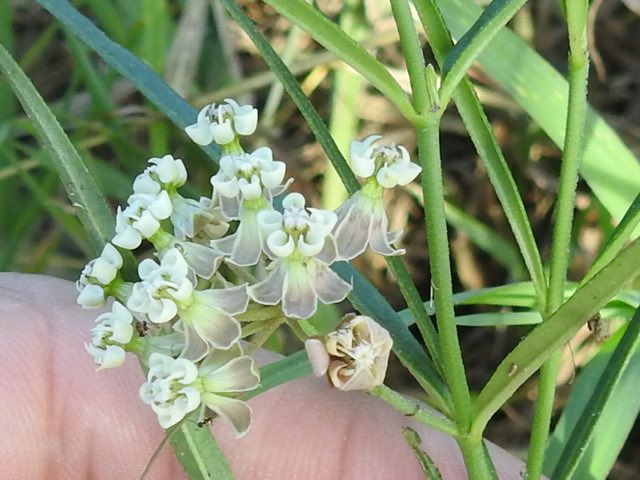
- Small greenish-white flowers, occasionally brownish or purple-tinged, with a white gynostegium.
Unfamiliar words are in the glossary, and the identification key will narrow a plant down from what you can see.
Ecology and wildlife value
A prairie specialist on the Texas Gulf Coast, where almost all of its habitat has been lost to agriculture and development. It flowers over a long season from late spring into autumn, which makes it useful to monarchs on both legs of the migration through Texas.
Monarchs are not the only thing that will find it. Expect large milkweed bugs on ripening pods, oleander aphids on the stems, red milkweed beetles at the flowers and, in late summer, milkweed tussock moths. Everything that lives on milkweed.
Growing slim milkweed
Rarely offered, and then only by Texas native-plant nurseries. Needs full sun and sharp drainage, and dislikes winter wet.
Seed needs about 30 days of cold-moist stratification. Deep taproot, resents transplanting. See how to plant milkweed seed for the full method.
Cautions
Standard milkweed cautions. A narrowly distributed endemic; buy nursery-grown plants rather than collecting from the wild. More on milkweed toxicity.
Where slim milkweed grows
Recorded in 1 state: Texas.
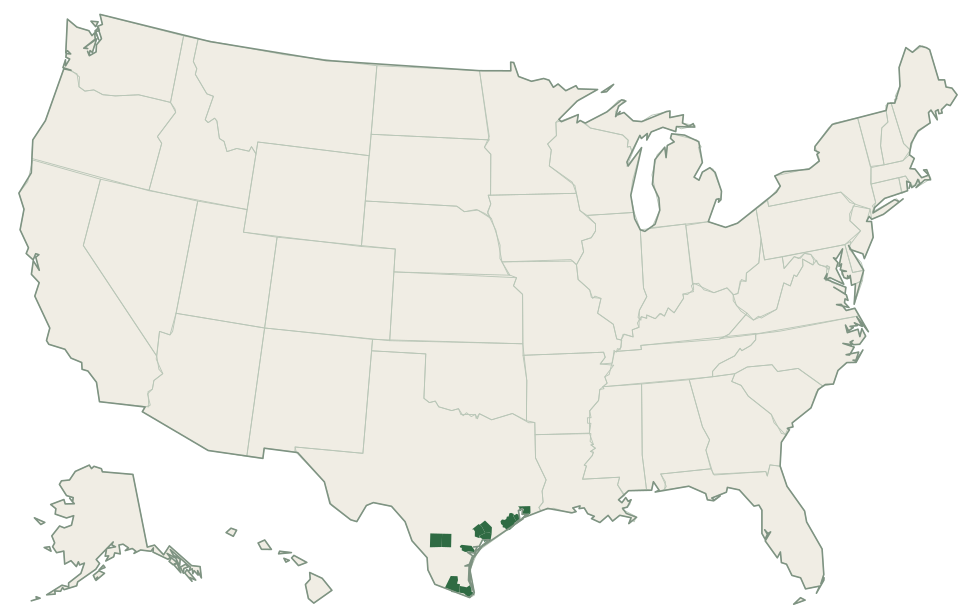
County records from USDA PLANTS, public domain. Cross-check against BONAP and your regional flora before making management decisions.
Frequently asked questions
Is slim milkweed the same as whorled milkweed?
No, though they look alike at a glance and both have thread-fine leaves. Whorled milkweed (Asclepias verticillata) carries its leaves in whorls of four to six around the stem and grows across most of the eastern and central United States. Slim milkweed has opposite leaves and grows only in Texas.
Is Asclepias linearis native to Maryland?
No. The USDA PLANTS database lists it for Maryland, but every flora treats it as a Texas endemic reaching into Tamaulipas in northeastern Mexico, and GBIF holds no Maryland records. Treat the USDA entry as an error.
References and further reading
Names, ranges and conservation status here are drawn from the databases below. Where those disagree with a regional flora, trust the flora.
- Woodson, R. E. (1954). The North American species of Asclepias L.. Annals of the Missouri Botanical Garden 41(1): 1–211. The monograph the modern taxonomy of the genus still rests on. View
- Flora of North America Editorial Committee (eds.) (2026). Flora of North America North of Mexico. Oxford University Press, New York and Oxford. Accepted names, keys and descriptions for the North American flora. View
- Royal Botanic Gardens, Kew (2026). Plants of the World Online. Facilitated by the Royal Botanic Gardens, Kew. Nomenclature and global distribution, keyed to IPNI name identifiers. View
- Kartesz, J. T. (Biota of North America Program) (2026). North American Plant Atlas. BONAP, Chapel Hill, North Carolina. County-level distribution maps, the basis for the ranges generalized here. View
- USDA, NRCS (2026). The PLANTS Database. National Plant Data Team, Greensboro, North Carolina. State-level distribution, wetland status and nomenclature. View
- Agrawal, A. A. (2017). Monarchs and Milkweed: A Migrating Butterfly, a Poisonous Plant, and Their Remarkable Story of Coevolution. Princeton University Press. The standard general account of the milkweed and monarch relationship. View
Cite this page
This page is licensed CC BY 4.0. Quote it, adapt it and reuse it, including commercially, as long as you credit Milkweed USA and link back.
Milkweed USA. (2026). Slim Milkweed (Asclepias linearis). Retrieved DATE, from https://milkweedusa.com/species/slim-milkweed/
"Slim Milkweed (Asclepias linearis)." Milkweed USA, 2026, https://milkweedusa.com/species/slim-milkweed/. Accessed DATE.
Milkweed USA. "Slim Milkweed (Asclepias linearis)." Last modified 2026-08-01. Accessed DATE. https://milkweedusa.com/species/slim-milkweed/.
@misc{milkweedusa_speciesslimmilkweed,
  title  = {Slim Milkweed (Asclepias linearis)},
  author = {{Milkweed USA}},
  year   = {2026},
  url    = {https://milkweedusa.com/species/slim-milkweed/},
  note   = {Accessed DATE}
}