Nodding Milkweed
Asclepias elata Benth.
The milkweed that United States sources have long called nodding milkweed: a single unbranched waxy stem in sky-island canyons from southeastern Arizona to the Trans-Pecos, carrying hanging umbels of green flowers with white and tan hoods. For most of a century it was filed under the Mexican Asclepias glaucescens, which does not reach the United States at all.
Also called Tall Milkweed.
- Height
- 1 ft–2.6 ft
- Spread
- 10 in–1.7 ft
- Flowers
- green, white
- Bloom
- June to September
- Light
- Part shade, Full sun
- Soil moisture
- Dry, Average
- USDA zones
- 7–10
- Leaves
- Opposite, elliptic
- Sap
- Milky latex
- Roots
- Rhizomatous, spreads by root
- Stratification
- 30 days cold-moist
- Range
- 3 states
When it flowers
Nodding Milkweed blooms June to September, peaking in July and August.
How to identify it
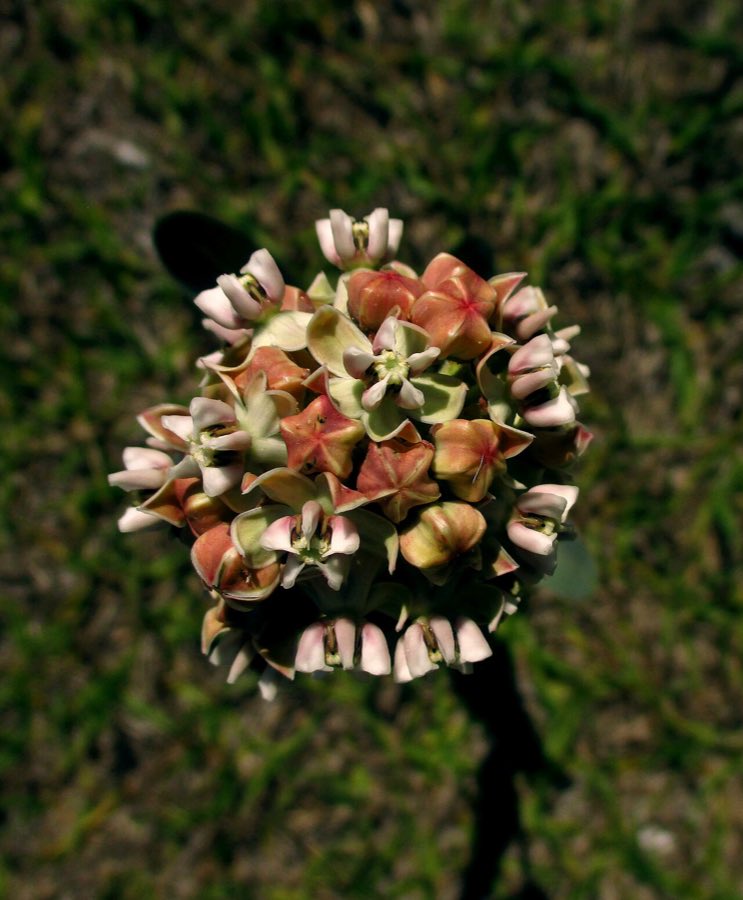
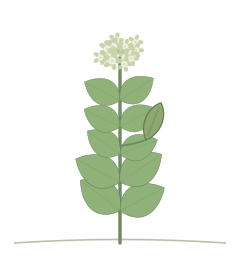
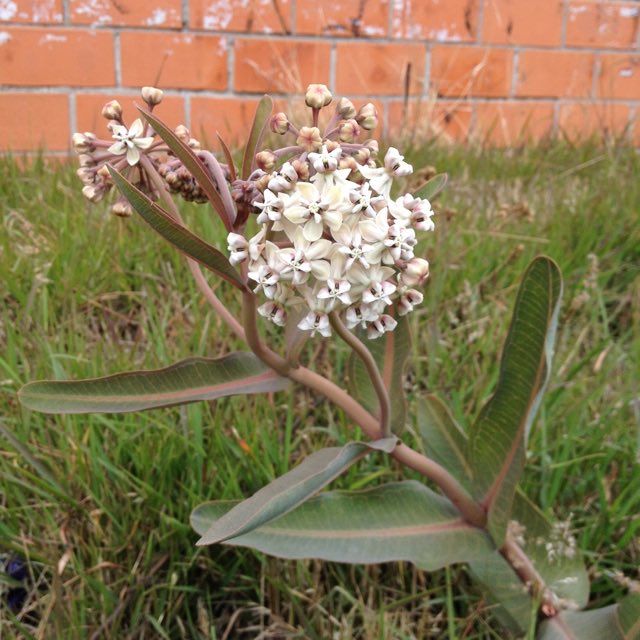
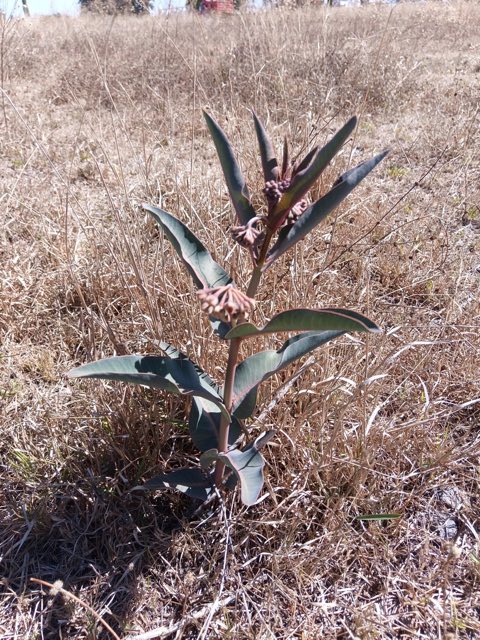
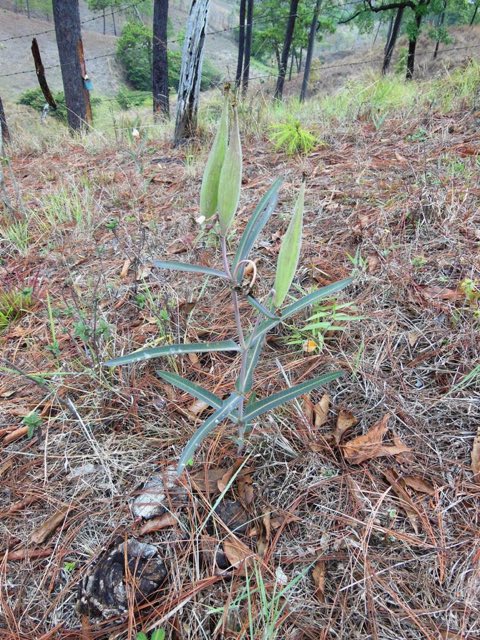
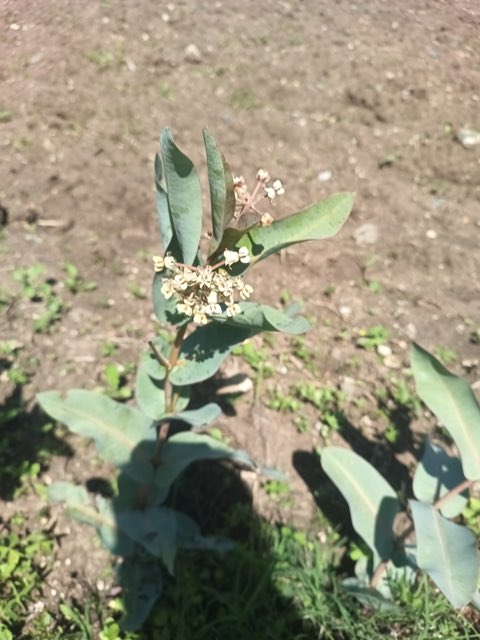
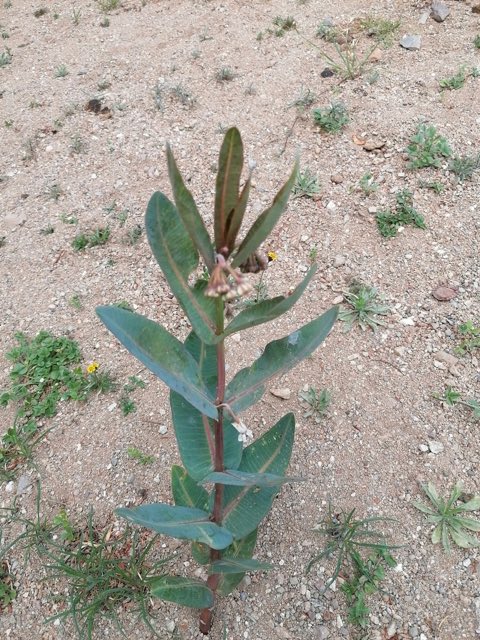
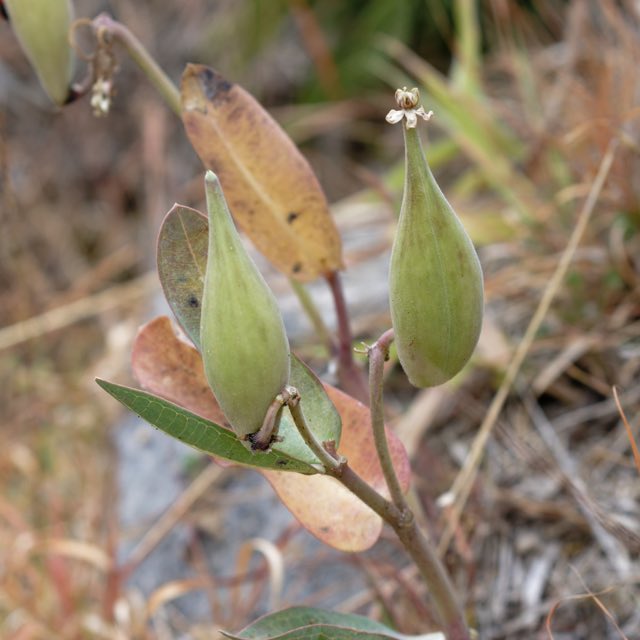
- One erect unbranched stem, rarely two or three, 30 to 80 cm tall, hairless and waxy blue-green.
- Opposite stalkless leaves, oval to oblong or lanceolate, 5.5 to 14 cm long, slightly fleshy, with a heart-shaped base that clasps the stem.
- Umbels of 7 to 20 fully hanging flowers on a stalk 5 to 20 cm long.
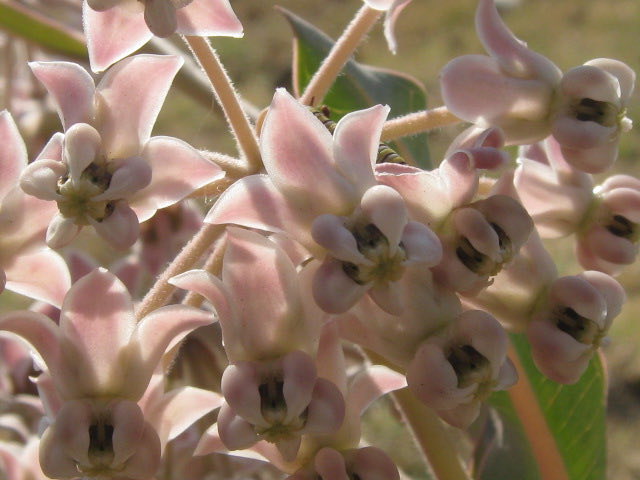
- Green corolla lobes 11 to 14 mm long, reflexed with spreading tips.
- Hoods white, yellow to tan on the back, shorter than the style apex, with the inner appendage a crest held inside the hood rather than sticking out.
Unfamiliar words are in the glossary, and the identification key will narrow a plant down from what you can see.
Ecology and wildlife value
A summer-rain plant of canyons, arroyos and pine-oak woodland between 1,200 and 2,200 m, flowering from June into September once the monsoon arrives. It is the only member in the United States of a small clade of waxy-leaved milkweeds that runs south to Costa Rica, and it reaches its northwestern limit in Arizona, a pattern it shares with Asclepias brachystephana, A. involucrata, A. nummularia, A. oenotheroides and A. quinquedentata.
Monarchs are not the only thing that will find it. Expect large milkweed bugs on ripening pods, oleander aphids on the stems, red milkweed beetles at the flowers and, in late summer, milkweed tussock moths. Everything that lives on milkweed.
Growing nodding milkweed
Not in cultivation and not commercially available.
Seed needs about 30 days of cold-moist stratification. Rhizomatous, spreads by root. See how to plant milkweed seed for the full method.
Cautions
Standard milkweed cautions. The sap is milky and irritating to eyes and skin. More on milkweed toxicity.
Where nodding milkweed grows
Recorded in 3 states: Arizona, New Mexico, Texas.
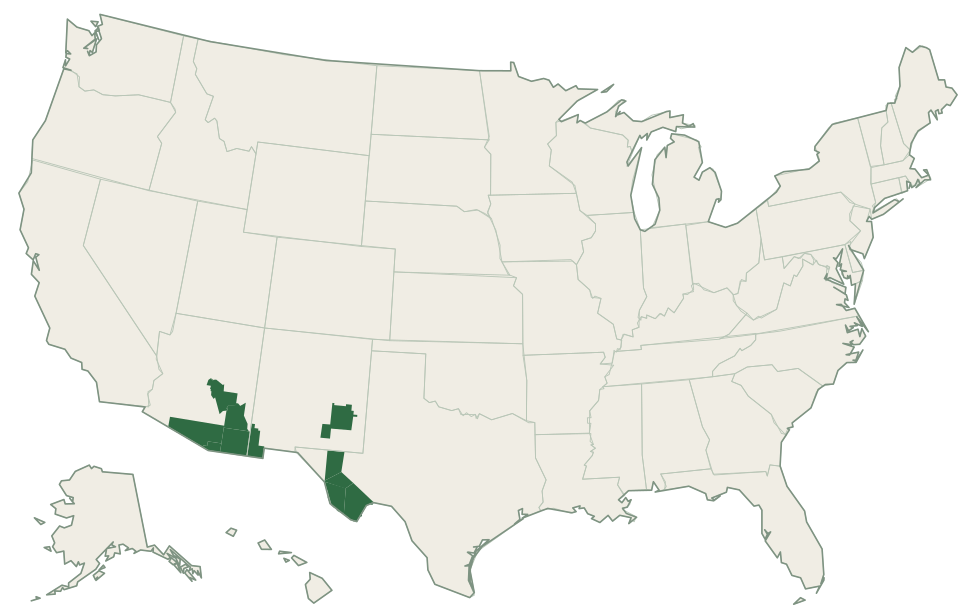
County records from USDA PLANTS, public domain. Cross-check against BONAP and your regional flora before making management decisions.
Frequently asked questions
Does Asclepias glaucescens grow in the United States?
No. Flora of North America does not treat it for the area north of Mexico, and its account of Asclepias elata states that the northernmost populations of A. glaucescens are in Nayarit and San Luis Potosi, both well inside central Mexico. United States records under that name are Asclepias elata. The two were only inconsistently separated from the 1870s onward, and although J. N. Rose set out the distinction in 1892 and R. E. Woodson restated it in 1954, the older name stuck in herbaria and databases.
How do I tell Asclepias elata from Asclepias glaucescens?
Not by the leaves, which are effectively identical, and in practice not at all in the United States, where only elata occurs. Where the two do meet, in Mesoamerica, elata has fully hanging flowers rather than erect to hanging ones, fewer flowers per umbel, longer corolla lobes, and hoods that spread away from the central column and are overtopped by the style, with the inner appendage a crest tucked inside. Glaucescens holds its hoods upright, overtopping the style, with the appendage sticking out.
Where does nodding milkweed grow?
In Arizona it is recorded from Cochise, Graham, Pima and Santa Cruz counties; in New Mexico from Eddy, Hidalgo and Sierra counties; and in Texas from the Trans-Pecos. Its range continues south through Mexico to Guatemala. The USDA PLANTS database holds no state distribution for it at all, which is a gap in that database rather than evidence of absence.
References and further reading
Names, ranges and conservation status here are drawn from the databases below. Where those disagree with a regional flora, trust the flora.
- Plants of the World Online 94250-1. Royal Botanic Gardens, Kew. Accepted name, authorship and global distribution.
- GBIF 3170303. Global Biodiversity Information Facility. Aggregated occurrence records.
- iNaturalist 284339. Community observations, photographs and phenology.
- BONAP county distribution map. Biota of North America Program. County-level range map.
- NatureServe Explorer. Conservation status ranks at global and state level.
- World Flora Online. Nomenclature and synonymy.
- Woodson, R. E. (1954). The North American species of Asclepias L.. Annals of the Missouri Botanical Garden 41(1): 1–211. The monograph the modern taxonomy of the genus still rests on. View
- Flora of North America Editorial Committee (eds.) (2026). Flora of North America North of Mexico. Oxford University Press, New York and Oxford. Accepted names, keys and descriptions for the North American flora. View
- Royal Botanic Gardens, Kew (2026). Plants of the World Online. Facilitated by the Royal Botanic Gardens, Kew. Nomenclature and global distribution, keyed to IPNI name identifiers. View
- Kartesz, J. T. (Biota of North America Program) (2026). North American Plant Atlas. BONAP, Chapel Hill, North Carolina. County-level distribution maps, the basis for the ranges generalized here. View
- USDA, NRCS (2026). The PLANTS Database. National Plant Data Team, Greensboro, North Carolina. State-level distribution, wetland status and nomenclature. View
- Agrawal, A. A. (2017). Monarchs and Milkweed: A Migrating Butterfly, a Poisonous Plant, and Their Remarkable Story of Coevolution. Princeton University Press. The standard general account of the milkweed and monarch relationship. View
Cite this page
This page is licensed CC BY 4.0. Quote it, adapt it and reuse it, including commercially, as long as you credit Milkweed USA and link back.
Milkweed USA. (2026). Nodding Milkweed (Asclepias elata). Retrieved DATE, from https://milkweedusa.com/species/nodding-milkweed/
"Nodding Milkweed (Asclepias elata)." Milkweed USA, 2026, https://milkweedusa.com/species/nodding-milkweed/. Accessed DATE.
Milkweed USA. "Nodding Milkweed (Asclepias elata)." Last modified 2026-08-01. Accessed DATE. https://milkweedusa.com/species/nodding-milkweed/.
@misc{milkweedusa_speciesnoddingmilkweed,
  title  = {Nodding Milkweed (Asclepias elata)},
  author = {{Milkweed USA}},
  year   = {2026},
  url    = {https://milkweedusa.com/species/nodding-milkweed/},
  note   = {Accessed DATE}
}