Cutler's Milkweed
Asclepias cutleri Woodson
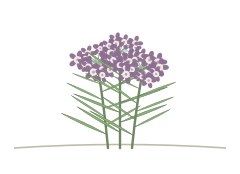
A sand dune specialist of the Four Corners, and one of the smallest milkweeds in North America at barely a hand's width tall. Purple flowers with off-white hoods on thread-fine leaves, growing in loose sand that moves underfoot.
- Height
- 4 in–8 in
- Spread
- 6 in–1 ft
- Flowers
- purple, pink, white
- Bloom
- April to June
- Light
- Full sun
- Soil moisture
- Dry
- USDA zones
- 5–8
- Leaves
- Alternate, threadlike
- Sap
- Milky latex
- Roots
- Deep taproot, resents transplanting
- Stratification
- 30 days cold-moist
- Range
- 2 states
When it flowers
Cutler's Milkweed blooms April to June, peaking in May.
How to identify it
- Very small: a perennial herb only 10 to 20 cm high, with ascending stems sparingly branched near the base.
- Thread-fine leaves, narrowly linear, 1 to 8 cm long and just 1 to 3 mm wide, set irregularly alternate along the stem.
- Purple to pinkish petals with off-white hoods, flowering early, from April to June.
- Weakly stabilized sand and gravelly ground between about 4,300 and 5,200 feet. Nothing else this small grows in that habitat.
Unfamiliar words are in the glossary, and the identification key will narrow a plant down from what you can see.
Ecology and wildlife value
A narrow endemic of the Colorado Plateau, much of its range on Navajo Nation land. Its value to monarchs is modest simply because there is so little of it, but shifting sand habitat is scarce and losing it loses the species.
Monarchs are not the only thing that will find it. Expect large milkweed bugs on ripening pods, oleander aphids on the stems, red milkweed beetles at the flowers and, in late summer, milkweed tussock moths. Everything that lives on milkweed.
Growing cutler's milkweed
Not cultivated and not available. It is here to be identified and reported, not grown. Sand dune endemics are easily destroyed by vehicle traffic, and a population can be lost in an afternoon.
Seed needs about 30 days of cold-moist stratification. Deep taproot, resents transplanting. See how to plant milkweed seed for the full method.
Cautions
Standard milkweed cautions. Do not collect: this species exists in a handful of places and nowhere else. More on milkweed toxicity.
Where cutler's milkweed grows
Recorded in 2 states: Arizona, Utah.
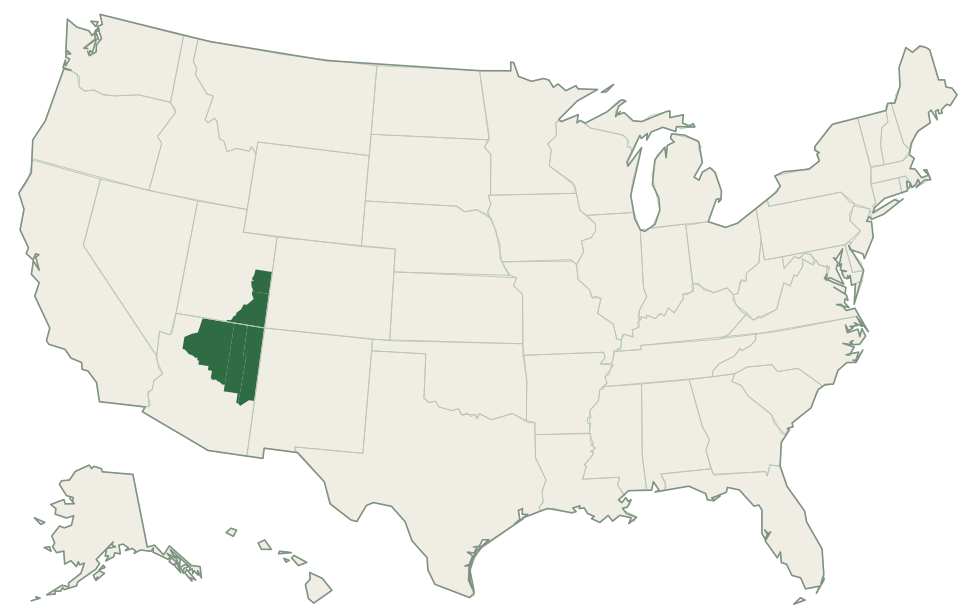
County records from USDA PLANTS, public domain. Cross-check against BONAP and your regional flora before making management decisions.
Frequently asked questions
How small is Cutler's milkweed?
Ten to twenty centimetres, so about the length of your hand. Its leaves are thread-fine, between one and three millimetres wide. It is easy to walk past and easy to mistake for a grass until it flowers.
Where does Cutler's milkweed grow?
The Four Corners, on sand. USDA records it for northern Arizona and southeastern Utah; some treatments also report it from Colorado. It is a dune and sandy-ground specialist and it occurs nowhere outside the Colorado Plateau.
References and further reading
Names, ranges and conservation status here are drawn from the databases below. Where those disagree with a regional flora, trust the flora.
- Plants of the World Online 21177-2. Royal Botanic Gardens, Kew. Accepted name, authorship and global distribution.
- GBIF 3170324. Global Biodiversity Information Facility. Aggregated occurrence records.
- iNaturalist 158736. Community observations, photographs and phenology.
- BONAP county distribution map. Biota of North America Program. County-level range map.
- NatureServe Explorer. Conservation status ranks at global and state level.
- World Flora Online. Nomenclature and synonymy.
- Woodson, R. E. (1954). The North American species of Asclepias L.. Annals of the Missouri Botanical Garden 41(1): 1–211. The monograph the modern taxonomy of the genus still rests on. View
- Flora of North America Editorial Committee (eds.) (2026). Flora of North America North of Mexico. Oxford University Press, New York and Oxford. Accepted names, keys and descriptions for the North American flora. View
- Royal Botanic Gardens, Kew (2026). Plants of the World Online. Facilitated by the Royal Botanic Gardens, Kew. Nomenclature and global distribution, keyed to IPNI name identifiers. View
- Kartesz, J. T. (Biota of North America Program) (2026). North American Plant Atlas. BONAP, Chapel Hill, North Carolina. County-level distribution maps, the basis for the ranges generalized here. View
- USDA, NRCS (2026). The PLANTS Database. National Plant Data Team, Greensboro, North Carolina. State-level distribution, wetland status and nomenclature. View
- Agrawal, A. A. (2017). Monarchs and Milkweed: A Migrating Butterfly, a Poisonous Plant, and Their Remarkable Story of Coevolution. Princeton University Press. The standard general account of the milkweed and monarch relationship. View
Cite this page
This page is licensed CC BY 4.0. Quote it, adapt it and reuse it, including commercially, as long as you credit Milkweed USA and link back.
Milkweed USA. (2026). Cutler's Milkweed (Asclepias cutleri). Retrieved DATE, from https://milkweedusa.com/species/cutlers-milkweed/
"Cutler's Milkweed (Asclepias cutleri)." Milkweed USA, 2026, https://milkweedusa.com/species/cutlers-milkweed/. Accessed DATE.
Milkweed USA. "Cutler's Milkweed (Asclepias cutleri)." Last modified 2026-08-01. Accessed DATE. https://milkweedusa.com/species/cutlers-milkweed/.
@misc{milkweedusa_speciescutlersmilkweed,
  title  = {Cutler's Milkweed (Asclepias cutleri)},
  author = {{Milkweed USA}},
  year   = {2026},
  url    = {https://milkweedusa.com/species/cutlers-milkweed/},
  note   = {Accessed DATE}
}